The Glen of Aherlow has received a major international tourism boost after National Geographic featured the Tipperary valley as a hidden corner of “true Ireland”, celebrating its spectacular landscape, ancient heritage and strong local traditions.
Travel writer Andrea Bussell shines a spotlight on the Glen in a National Geographic feature published on August 3rd, describing the area as a destination well worth discovering for visitors seeking a quieter and more authentic experience of rural Ireland. Headlined “Welcome to ‘true Ireland’—a hidden valley filled with ancient lore”, the feature introduces an international readership to a valley which Bussell notes remains relatively unknown, even among some Irish people.
Situated between the Galtee Mountains and the forest-covered ridge of Slievenamuck, the Glen of Aherlow is described by Bussell as a place made for “slower, nature-centric journeys.” Her description of the landscape captures what has long made the Glen special to those who live in and visit the area, with Bussell writing of “tall emerald mountains rising from flower-strewn meadows” as she paints a picture of the Galtees overlooking farmland, cattle and extensive woodland.
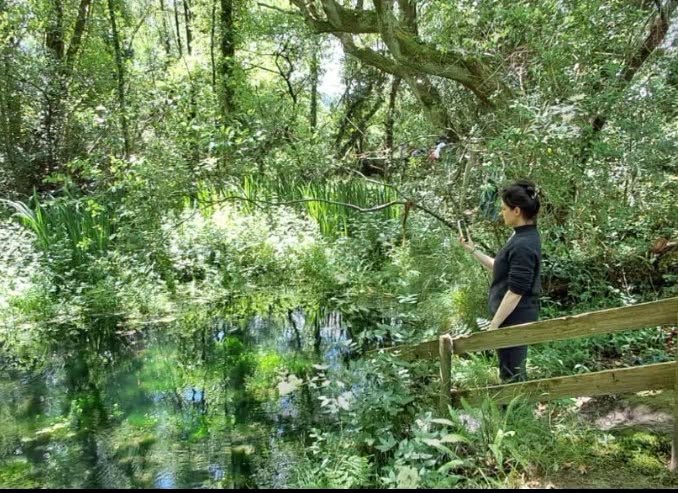
But it is not just the scenery that attracts National Geographic’s attention. Bussell ventures beyond the better-known viewpoints to discover the remarkable history lying quietly throughout the countryside. She describes “wild fields that hide ancient, unmarked sites”, where stories, customs and traditions have been passed from generation to generation by local people. That sense of discovery runs throughout the National Geographic feature.
Among the sites highlighted is the Mount Russell Ogham Stone, believed to date from the fifth or sixth century and bearing Ogham, Ireland’s earliest form of writing. Bussell also draws attention to the impressive remains of Moor Abbey on the banks of the River Aherlow. The Franciscan friary has a long and turbulent history, with archaeological excavations uncovering ancient grave slabs beneath the site.
On Slievenamuck, she highlights another remarkable piece of the area’s heritage — the Shrough Dolmen, a hilltop passage tomb dating back approximately 5,000 years and described in the article as County Tipperary’s only confirmed passage tomb of its type.
The Glen’s holy wells and the traditions surrounding them also feature prominently. At St. Berrihert’s Kyle and Well, Bussell describes an oval stone enclosure containing cross slabs believed to date from the seventh century. Around the site are reminders that its traditions have continued into modern times, with toys, coins, candles, beads and other tokens left behind by visitors.
The ritual associated with the well — circling it, drinking from its waters and leaving a token — has, Bussell reports, been practised for generations.
The National Geographic feature also recognises that the heritage of the Glen is not confined to ancient monuments. Bussell visits Corderry Farm, where the Ivory family has cultivated the land since the 1700s. Across its 250 acres are historic sites including dolmens, a mass rock and the ruins of cottages and famine houses, alongside the farming and forestry traditions which continue on the land today.
The importance of local knowledge emerges as one of the strongest themes of the article. Speaking to Bussell, Ailish O’Donnell Ivory sums up what distinguishes the area from more heavily developed tourism destinations: “This is true Ireland.” She explains that visitors to the Glen have an opportunity to meet and speak with local people and hear stories which could otherwise be lost if they were not passed from one generation to another.
Walking guide and author Jimmy Barry similarly tells National Geographic that while the Glen is used and enjoyed, “we’re really hidden away.” That hidden quality is part of what Bussell finds so appealing. Walking is described as “one of the best ways to explore the Glen,” with National Geographic highlighting eight scenic circular trails ranging from lower-level woodland walks to mountain routes into the Galtees. The Lough Curra and Lake Muskry walks are singled out as memorable routes into the mountains, while the Ballyhoura Way and Tipperary Heritage Way also bring walkers through the wider region.
Bussell’s journey also introduces readers to another important local tradition — beekeeping. She visits Galtee Honey Farm, where a fourth generation of the Mac Giolla Coda family maintains more than 170 colonies of Ireland’s threatened native black honeybee. The farm sits beside Glengarra Wood in an area which became one of the country’s early conservation areas for the Irish black bee.
The Glen of Aherlow Scenic Drive, Christ the King viewpoint and the wider attractions of County Tipperary also receive attention, with Bussell connecting the quieter heritage of the Glen with internationally recognised landmarks such as the Rock of Cashel.
For the Glen of Aherlow and the wider Tipperary tourism sector, appearing in National Geographic represents valuable international recognition. What makes the feature particularly significant is the way Bussell presents the Glen. Rather than portraying it simply as another scenic destination, she depicts a living landscape where mountains, forests and farmland exist alongside thousands of years of archaeology, folklore and traditions still maintained by local communities. Her description of a “hidden valley filled with ancient lore” captures much of what makes the area distinctive.
For generations, the Glen’s scenery, ancient monuments, holy wells, walking routes and local stories have been familiar to the people who call the area home. Now, thanks to National Geographic, a worldwide audience is being invited to discover them too.
Read Andrea Bussell’s full National Geographic article; https://www.nationalgeographic.com/travel/article/mysterious-ancient-sites-ireland